Legends from our own lunchtimes

Saturday, September 15, 2018

The “New” Tower.
Thursday 13th September - Diksmuide


After more than a week of staring at the thing, we finally popped across the bridge to scale the dizzy heights of the Yser Tower.  Not that scaling it took a great deal of effort once we’d pressed the “close door” button on the lift, but there were still four flights of stairs to negotiate to get to roof deck which made it seem like a small victory.

The monuments have struggled at times to close the gap between Peace and Flemish Nationalism, but the fact that “Peace” gate was built from the rubble of the first tower which was destroyed by Anti-Nationalists, and that much of the main tower is constructed from the war-remnants of buildings from many of the villages and cities of Belgium makes the intent quite clear.

Here we are.  On the roof of a twenty-two storey building filled with artefacts and exhibitions which tell a story of horror so great that it will remain beyond our comprehension.  We can see the whole of the town, the fields that now hide so much of a truly grizzly history, and even the edge of the earth. 

Yet all we can do is gasp and say: “Look!  There’s our boat!”
SHARE:

The Man in the Moon.
Wednesday 12th September - Diksmuide


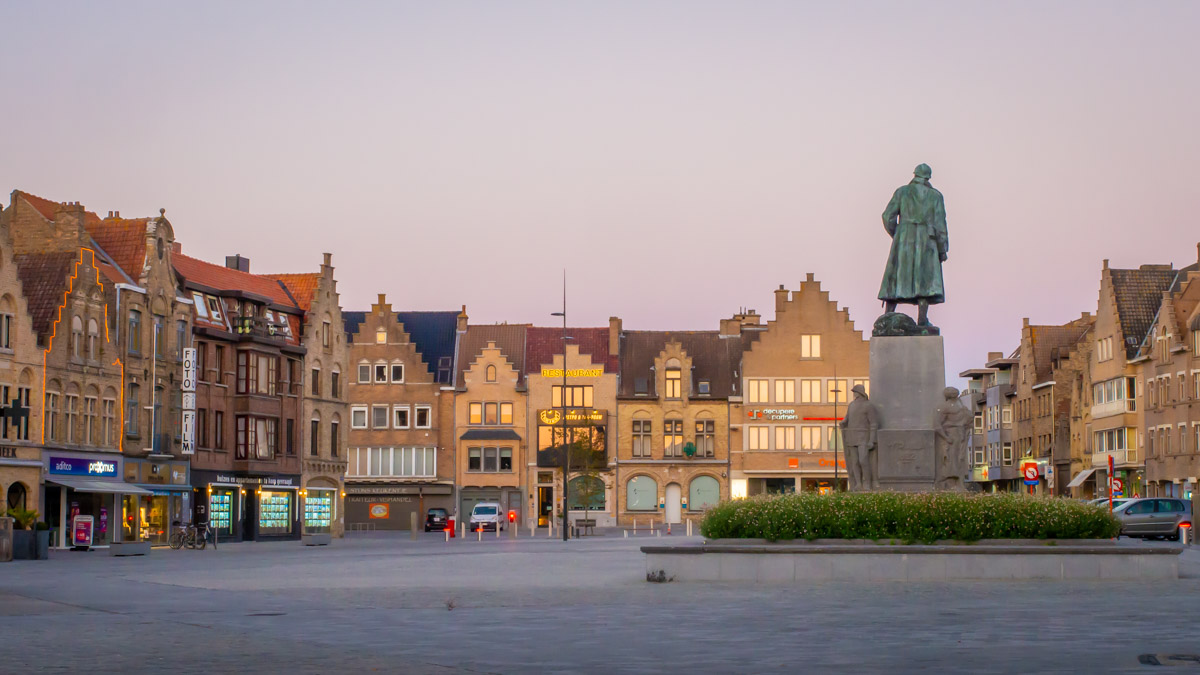
The Market Square in Diksmuide is famous, according to the internet for its two prominent sculpture pieces.  There is the solemn if just a little tilted, effigy of Général Jacques described yesterday, who seems to have his back turned in silent protest against the flippant goings-on in the near corner, and there’s the flippancy itself.

In the past week we’ve learned quite a lot about the cheery little “Manneke uit de Mane”.  The gilded statue that stands out somewhat discordantly, like a beacon to happiness. That same internet would have it that one time Prime Minister Leo Tindemans was its sculptor.  That does seem unlikely, but he was definitely “beaten” into a knighthood of the “Order of the Man in the Moon”, a not entirely secret society which among other things bestows this honour from time to time on prominent citizens of West Flanders.

This all apparently originated from the publication of a Flemish Folk Almanac filled with jokes, weather forecasts and old Flemish sayings, wisdoms and customs which is still printed occasionally.  Perhaps the Général is just miffed that he didn’t know the secret handshake.
SHARE:

Peek-a-boo!
Tuesday 11th September - Diksmuide


Jules Marie Alphonse Jacques, 1st Baron Jacques de Dixmude, (Général Jacques to his mates) was an all round good bloke it would seem.  Having lent a bit of a hand in darkest Africa cleaning up the nasty slave trade whilst still a mere Captain, he went on to become such a heroic commander of troops that immediately after the First World War he was elevated to the Nobility.

He is remembered fondly in a bronze effigy which when viewed from most angles portrays him as a picture of strength and leadership. It stands tall right there, not quite in the centre of the market square of the town he is credited with defending so valiantly.  He’s curiously positioned though, neither addressing nor defending the public buildings in the more traditional siting of such monuments.

Instead, he’s peering down Railway Street, and when viewed from the rear he has a curious tilt. Is he we wonder, ever vigilant, watching westward on the town’s behalf to be sure the nasty blighters aren’t sneaking back while everyone’s in bed, or simply waiting to surprise a grandchild hiding in a doorway?
SHARE:

Monday is Market Day.
Monday 10th September - Diksmuide


“Market Day” is not necessarily high on our list of things to visit, but since this was our first for here, we braced ourselves and we took the plunge.  The "Big Marketplace" did contain more people present than we’d ever seen before in one place in Diksmuide, but if we had added up the numbers the total would certainly not have qualified as a “crowd”, perhaps more a “small gathering”.  As has been our usual experience in markets of this ilk, a smattering of quality food product stood out among an otherwise forgettable collection of trinkets and the sort of clothing a person would not be seen in even after his time on earth had expired.  Strangely perhaps despite the fresh produce on offer, the greatest gathering of folk seemed to be around the various take away food vans.

Still not quite up to speed with the way the town works, we asked the nice man in an electronics shop why he was closed on Tuesdays.  

“Because Monday is market day” he replied ever so helpfully, as though that explained everything.  There were vague warning bells ringing in our heads though; Is it possible, we wondered, that indulging in market hot dog cheeriness is the kind of activity that needs a prolonged recovery time?

SHARE:

Friday, September 14, 2018

Living a Dream.
Sunday 9th September - Lelystad to Diksmuide via Antwerp.


It was not difficult as we ambled around the waterfront in the warmth of the evening in Antwerp after a delightful meal, and a delightful weekend for that matter, to find ourselves entirely content and perhaps more grateful than usual with our particular lot. There is no doubt that we are living in some sort of dream.

Oh it’s true that our eyes were still stinging a bit, perhaps from a day spent outdoors in the breeze, or perhaps from reading the price tags on the boats and accessories on display.   We had also been a little disconcerted to discover that after a decade of not too diligent searching, while the boat of our dreams did exist, the cost of realising that particular dream would require several extra lifetimes of saving.  

Apart from experiencing the temporary emotional fizz of unwrapping a new toy, it’s hard to imagine how forsaking our perfectly comfortable if heavily patinated floating home for something bright and shiny could bring greater happiness.   It would admittedly bring more warmth, arguably more reliability, seaworthiness and certainly less damp, but how could we be happier?  

Besides, what would be left to dream about?
SHARE:

Tuesday, September 11, 2018

Tragic.
Saturday 7th September - Lelystad


The evolution of the English language is a terrifying albeit wondrous thing.  It’s terrifying when change occurs through laziness, when grammar and spelling evolve needlessly in a way that detracts from the joy of expression in that language, yet wondrous when words evolve through that same misuse, to succinctly define the previously less well defined.

One example that comes to mind, is the preposterous use of “tragic” as a noun,.  This it appears is a peculiarly Australian habit, which from at least a colonialist’s perspective is entirely more acceptable than allowing Americanisms to sneak up on us.   The  Macmillan Dictionary describes it thus:

TRAGIC - NOUN [COUNTABLE] AUSTRALIAN INFORMAL HUMOROUS - Someone whose interest in a particular sport or activity is so strong that other people find it strange or silly.

“Boat Tragics” - When four people who live on boats fold themselves into a Mini for four hours so they can stay overnight on a houseboat in a harbour in another country, in order to get an early start to visit an on-water boat show the next day.  

Better get a picture of this Ria, “ How did you fit the drone in?”
SHARE:

Around Here, the Earth IS Flat.
Friday 6th September - Diksmuide


We have lived on the waterways of Europe for a decade of summers, yet we still find it vaguely amusing if not confusing to find substantial pleasure boat ports in the hearts of towns which themselves seem to be in the middle of nowhere.   Generally these ports are considered by the residents of the towns to be eccentric curiosities, rather than “attractions” as may be the case in other places.

This is understandable since the waterways in much of Europe were created as industrial corridors and were traditionally less than desirable places to actually live.  It came almost as a shock to find that here waterfront property seems to command more of the premium with which we are familiar.

The docks of Diksmuide were once lined with buildings of a somewhat more utilitarian nature; tall silos in brick which had long since served their purpose.  Modern constructions were constructed more or less of the same scale and height as the buildings that they replaced, coincidentally on what appears to be the highest land as far as the eye can see.  While from our perspective it would appear that they are built overlooking the water, the fact of the matter is that that is exactly what they do; they overlook it.  We are reliably informed that even from the first level the edge of world is clearly visible across the plains, which surely must give the occupants some comfort when ugly arguments arise regarding the form of our little planet. 
SHARE:
Blogger Template Created by pipdig